Sultans of Learning Guitar
Six evidence-based learning principles, one impossible song, 30 days. I'm proving the science of rapid skill acquisition by learning Sultans of Swing and recording the whole thing.

I have the opportunity to play at A Night of Worship that my church is hosting. I haven’t played seriously in five years.
But I’m not starting from zero. When I was fifteen I played guitar in a country band — everyone else was in their seventies. In college I played constantly: hours a day, producing my own songs. Later I was leading worship in small settings. Guitar was the thing I did. Then life happened. Career, family, other obsessions. The calluses softened. The muscle memory faded.
Now I have this opportunity and I’m taking it seriously. Worship is something I care about deeply, and playing well enough to stop thinking about mechanics and actually be present in the moment? That matters to me. The reasonable thing would be to spend a month brushing up on worship songs. Learn the chord charts, run them at tempo, show up and play.
I’m not going to do the reasonable thing.
Instead, I’m going to learn Sultans of Swing by Dire Straits — one of the most technically demanding songs in the rock guitar canon. Hybrid picking, position shifts across the entire neck, dynamics that go from a whisper to a scream, the whole Knopfler fingerstyle thing.
Why?
Because if you can dodge a wrench, you can dodge a ball.
Sultans of Swing isn’t the goal. It’s the training method. It’s the wrench. If I can play Sultans clean at tempo — hybrid picking, position shifts, dynamics, all of it — then the worship set stops being something I have to survive and becomes something I can inhabit. I won’t be fretting about mechanics. (Accidental guitar pun. I’m keeping it.) The science of rapid skill acquisition backs this up: train above your target, and everything below it becomes automatic.
Here’s the deal: I have 30 days, starting February 3rd. I have 30-60 minutes a day. And I have a book that’s been making the rounds called The Science of Rapid Skill Acquisition that claims speed comes from method, not more hours. I’m going to take that claim seriously, back every piece of it with real research, build a system, and prove it works — or fail publicly.
Between now and then, I’m prepping the environment: watching the lesson videos, setting up the practice space, figuring out how my new drum machine works. No training yet, just jamming some old tunes I remember. When day one hits, the system is ready and the only variable is me.
The recording will be embedded at the end of this post.
The Launching Point
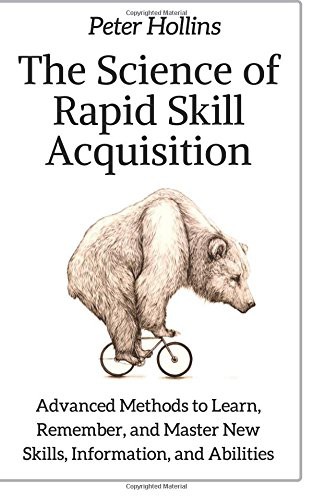
The Science of Rapid Skill Acquisition lays out twelve principles for learning anything fast. It’s a good book. But I’m not going to walk through all twelve — that’s a book report, not an experiment.
Instead, I pulled the six principles that matter most for this challenge. I’m not here to make the academic case for each one — the book does that, and the citations are there if you want to dig. What follows is what each principle says, why I buy it, and how it shows up in my daily practice.
This is an experiment, not a literature review. If you disagree with the science, take it up with the researchers. I’ll be busy practicing.
1. Deliberate Practice Beats “Just Playing”
Deliberate practice is goal-directed, feedback-rich, and deliberately uncomfortable — you target the thing you can’t do, isolate it, and work it until you can.
How I’m applying it: Every session has a micro-target. Not “practice Sultans.” Instead: “bars 17-24, verse-to-chorus transition, 80% tempo, clean double-stops.” Record a take at the end, write one note: what to fix tomorrow.
[I’ll add a concrete example here once training begins.]
2. Spacing > Cramming
Spaced practice beats massed practice for long-term retention — the most dependable finding in learning science. For a 30-day target, that means revisiting hard fragments every 1-3 days, not grinding 100 reps in one session. Motor memory consolidation happens between sessions, not during them.
How I’m applying it: I cycle difficult Sultans fragments on a spaced repetition schedule — the same algorithm behind Anki flashcards, applied to guitar licks. New chunks start on a 1-2-4-7 day revisit rhythm. Chunks I nail get pushed further out; chunks I fumble get pulled back in sooner. Over time, the easy stuff fades into maintenance and the hard stuff keeps surfacing until it sticks. Each day is one new chunk plus one old chunk from the review list. No marathon sessions. 30-60 focused minutes, then walk away and let sleep do its work.
[Will add a demo from the lick dictionary once we’re rolling.]
3. Interleaving (Even When It Feels Worse)
Blocked practice means drilling one thing repeatedly (AAABBBCCC). Interleaved practice means mixing tasks within a session (ABCABCABC). Blocked feels better. Interleaved is better — for retention and transfer.
How I’m applying it: I rotate between two micro-chunks per session instead of grinding one. For brand-new material, I start blocked to build basic accuracy, then switch to interleaved. Blocked for initial schema, interleaved for durable retention.
4. Retrieval Practice Is a Cheat Code
Testing yourself produces dramatically better long-term memory than re-studying. Only 11% of students spontaneously do it. The best-kept secret in learning, hidden in plain sight.
How I’m applying it: Every session starts with a “cold start.” First, I sing yesterday’s chunk — the rhythm, the melodic contour, just my voice. Then the guitar comes out of the case. No warmup. No peeking at the score. I play it from memory.
It’s ugly. It’s supposed to be.
The first few notes come out wrong. I second-guess the fingering on the position shift. The rhythm in bar 22 comes back garbled. Every instinct says to stop and look at the tabs. That instinct is wrong. The struggle to reconstruct the passage — the effortful retrieval — is the thing that strengthens the memory. Re-reading the tabs would feel productive but produce less learning.
After the cold attempt, I check the score, mark what I got wrong, and fix those specific spots. Two minutes that turn passive familiarity into durable recall.
5. Mental Rehearsal + Singing
Imagining a piano exercise expands the motor cortex the same way physical practice does. Add singing and you get significantly higher musical expression than physical practice alone. You want to play with more feeling? Sing it first.
How I’m applying it: Singing shows up twice in my day, in completely different contexts. First: it opens the cold start. Before I touch the guitar, I sing yesterday’s chunk. By the time I pick up the instrument, my body already knows where the music wants to go. Second: during dead time — commute, before bed, waiting in line — I sing the phrase rhythms and visualize the picking pattern and position shifts. No guitar required. Two different moments, same principle.
If you can sing it, you’re closer to playing it than you think.
6. Focus on the Sound, Not Your Fingers
Focus on what the movement produces (the sound), not the movement itself (your fingers). Internal focus triggers “micro-choking” — self-evaluation loops that constrain the automaticity you’re trying to build.
How I’m applying it: Cue phrases target sound and groove, not body mechanics. “Snap the notes to the click.” “Make the ghost notes whisper.” Not “move finger three to the seventh fret.”
The System — 30 Days, 30-60 Minutes
Six principles, but principles don’t practice themselves. Here’s how they stack into a daily system.
The Sultans “chunk method” is the engine. Day one: label the song’s sections and break it into 10-14 chunks — small enough to master in a session, big enough to feel musical. Each day: one NEW chunk (blocked practice, slow, perfect reps) plus one OLD chunk from the spaced review list (interleaved, played cold at target tempo).
Tempo rule: only increase when you nail two clean takes in a row. If it falls apart at the new tempo, drop back below the previous one — overshooting and retreating to a lower baseline keeps you from baking in sloppy muscle memory at the edge.
This structure gives you deliberate practice, spacing, interleaving, and retrieval practice baked into every session automatically.
The Daily Template
30 minutes (minimum effective dose)
- 1 min — Sing yesterday’s chunk (voice only, no guitar)
- 2 min — Cold start: play it from memory (retrieval)
- 10 min — TrueFire warmup: alternate days between CAGED/fretboard and hybrid picking/rhythm
- 14 min — Sultans micro-chunk work (the engine)
- 3 min — Record a take + write one note: “what to fix tomorrow”
45 minutes (recommended) Same structure, but Sultans becomes 20 min and add 5 min of jam-track micro-improv 3-4x/week.
60 minutes (max) Sultans becomes 30 min, worship block (once active) gets 15-20 min, and end with a full-song run-through 1-2x/week for stage simulation.
Weekly jam (once a week, any length) Turn on the SR-18, pick a groove, and just play. No score, no micro-targets, no chunk method. Just respond to the drum machine like it’s a bandmate. Record it. This is the part where the vocabulary you’ve been drilling all week turns into something that sounds like music instead of an exercise. I’ll post a clip from each week’s jam as proof-of-work along the way.

The Support System
Learning Sultans without broadening the underlying skills is like training one submission without knowing how to take down, pass, or pin. You might land it once, but you can’t get there reliably. The chunk method is the submission. The TrueFire warmup is the takedowns, passes, and pins.
TrueFire warmup (alternating days) — I’m rotating between two course tracks for variety and breadth. Day A: fretboard navigation via TrueFire’s CAGED System and CAGED Cracked. Day B: technique and rhythm via Chris Buono’s Guitar Gym: Hybrid Picking and Rhythm Lab: Rock & Funk. Ten minutes, pick up where you left off. This keeps the warmup from going stale and broadens the playing surface beyond just the song.
The Sultans Lick Deck — (This is a terrible name). This is vocabulary building — the same way you learn a language by collecting phrases, not memorizing grammar tables. Three times a week, I pick two micro-phrases from the song and run them through: perfect slow reps, tempo ladder, placement drill, and optionally move it to the next CAGED position. The weekly jam is where these phrases stop being drills and start becoming things I actually say.
The Resources
For Sultans itself:
- LickLibrary — Sultans of Swing — note-for-note lesson, primary resource (paid)
- GuitarLessons365 — Sultans lesson series — backup/alternate perspective (free)
- Hal Leonard — Mark Knopfler Guitar Styles Vol 1 — includes Sultans transcription (paid, book)
For broadening the playing surface:
- TrueFire CAGED System + CAGED Cracked — fretboard navigation (paid courses)
- Chris Buono’s Guitar Gym: Hybrid Picking — the technique engine (paid course)
- Greg Koch hybrid picking lessons + Andy Wood hybrid picking — creative applications (free articles)
- Rhythm Lab: Rock & Funk — timing and groove (paid course)
- TrueFire Jam Tracks — practice context (free)
For the worship set:
- WorshipArtistry practice loops — once the set list drops (paid, subscription)
What “Done” Looks Like
I’m not aiming for perfection. I’m aiming for deliberate, measured progress that’s miles from where I started.
The target: a multipart recorded take of Sultans of Swing at tempo. Clean articulation. Consistent dynamics. The hybrid picking sounds intentional, not accidental. It won’t be flawless — but it will be evidence that the system works.
The recording will be embedded right here when it’s done.
[Recording placeholder — the proof-of-work goes here]
The War
Here’s the tension I can’t resolve: this is a spreadsheet applied to something that isn’t a spreadsheet.
Every musician I respect would tell me to put the system down and just play. And every learning scientist would tell me that “just playing” is how people stay mediocre for decades. Both of them are right. I don’t know which one is more right for me, at this stage, for this project. That’s the actual experiment.
I know I’ll play Sultans of Swing eventually. I’ve played hard things before. The question isn’t whether — it’s by which route. Does the science accelerate the path, or does it get in the way? Does the system dissolve into music at some point, or does it calcify into something precise but lifeless? I genuinely don’t know. The weekly jams will tell me something. The final recording will tell me more. The worship night will tell me everything.
These six principles — deliberate practice, spacing, interleaving, retrieval, mental rehearsal, external focus — might apply to anything you want to learn. Coding. BJJ. Cooking. Languages. Or they might be a scaffolding that’s only useful until you don’t need it anymore, and the real skill is knowing when to tear it down.
Most people shy away from hard practice. They noodle, they repeat what’s comfortable, they take the long way around the mountain. That’s fine if you have years. I don’t. I have 30 days and a night of worship that matters to me. I can’t afford the scenic route — I need to find the direct one. The science is my best shot at that.
But music isn’t a mountain you summit. It’s something you inhabit. And I’m not sure a map can get you there.
Thirty days. Thirty to sixty minutes a day. Six principles. One impossible song. One war between the spreadsheet and the instrument.
Let’s find out.